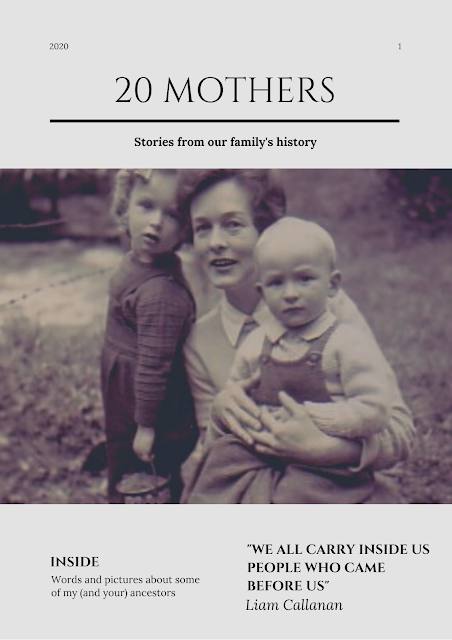
Why 20 Mothers?
I began writing short biographies of 20 of my female
ancestors in 2015. My aim was to write about
my family history in a way that would be meaningful for my descendants - in
terms of their interests and the ways they search for information.
Family historians accumulate names, dates and places, going
back and sideways as far as records will take them. There comes a point when this all becomes a
bit meaningless. You want to understand
their lives too, especially the ones who are your direct ancestors, because
they are most likely to have had some kind of influence on who you are today.
Hang on a second, you say, I never knew any of my great
great grandparents, not even one of them. How could they possibly have made a
difference to my life? They just handed down their genes, that’s all. Well, the circumstances of their lives
influenced those of their children, your great grandparents, which in turn… You
get what I mean now, don’t you?
One of my feistiest great great grandparents, Harriet Nye, from the
south of England, married George Read from the north of England in 1840. Just
a month after their Sussex marriage Harriet and George were on a ship bound for
South Australia. The colony at Adelaide had barely begun. What were they
thinking? After fathering five children, George shot off to the Victorian
goldfields, leaving pregnant Harriet in Adelaide to raise the children. How she supported them is beyond my
knowledge, though I found that George did send her one gold consignment from
Victoria. Three ounces of gold was worth a lot in 1852. In today’s Australian dollars I estimated it
would be worth over $1,000. Perhaps the gold saved her from having to seek
government aid. Life must have been tough for so many families whose husbands
had left for the gold rush. There were so many destitute people left behind
that the Adelaide Destitute Board at first refused to help those who were married. They
later relented because the needs were so great.
By 1859 Harriet gave up and returned with the children to England. She
never saw George again. She reminds me
of myself a little. I married a Malay man, moved to Malaysia and later returned
to Australia (though I kept in contact with my ex-husband Syed Ibrahim when he
came to Perth to visit his son Khalil).
(Extract from Harriet Nye, 20 Mothers)
So I moved from just collecting names and dates, to writing
about my family’s history. Many family
historians write heavy volumes about the men in their family, early farmers,
soldiers, political leaders, and so on. Some
family stories may even exaggerate the importance of their ancestors to make
the story sound a bit more interesting. The
“big book” project can go on for years and years. And in the end, who reads it?
Not always immediate descendants who may
secretly donate it to a second hand book shop. Maybe later generations and other family
history researchers will be glad of it, you hope. But will they seek out large printed books in
the future? Perhaps they will only search on the internet.
Not only that, but as soon as you’ve had it printed there
are changes to be made, information to be added, information found to be
incorrect, gaps which can now be filled or DNA test results which suggest you
have the wrong person in your tree. So
the big book can quickly become out of date or incorrect.
Family historians rack their brains to find engaging ways to
hand down the results of our research to our children and grandchildren. I realise
that how my descendants Khalil, Mika and Zak will search for and use information may be very different from the ways my recent ancestors and I have. And who knows what the future will
bring in terms of information storage and management?
I am also aware that Khalil, Mika and Zak may only become
interested in these stories long after I have gone – because that’s what
happened with me. I’ve often wished I’d
listened and recorded the family stories shared by my parents, grandparents and
other relatives.
So I came up with a different way to pass on the family’s
stories. Instead of a long and all-encompassing family history I decided just
to write short word pictures of individuals. Anything from a just few paragraphs to four or
five pages, focusing on my interesting female ancestors.
Female ancestors, because I wanted to try to
even up the gender balance, since men are more frequently recorded in
genealogical records and family histories.
I made a short list of the women ancestors I knew a bit about and soon
realised I could tell a whole family’s story through each woman. Because each was my direct female ancestor, they were all mothers -
hence my title 20 Mothers.
These shorter biographies were also chunks of
writing that were easier to fit into an active life.
Being shorter, perhaps they are more likely
to be read in this digital world. I have tried to use the social media strategy
of making the opening lines worthy of being called clickbait!
My word portraits include available images of each woman and
their family, and maybe a few of relevant locations, buildings, ships,
occupational references and maps. Even
if there are gaps in my knowledge about some of them, I have found it easy to
find something more general about the history of the place they lived, the
historical period, the way people lived and travelled then, the jobs they
did.
My list of women to write about
reached 20, with about the same number from my mother’s side of the family and
my father’s.
In 2016 I jumped into the complex world of genetic
genealogy, trying to connect with living cousins also descended from the same pair of ancestors because we share some DNA. So
I have added a chapter about DNA, the basis of genetic genealogy and DNA
testing for genealogy. It will still be
a big thing in family history long after I am gone.
So here, Khalil, Mika and Zak, are my 20 mothers and their families. They are my mother, my two grandmothers, my
four great grandmothers, right up to some of my 16 great great great
grandmothers… And so they are your ancestors too.
With much love to you
Jenni Kirby Ibrahim
Comments
Post a Comment